
INTRODUCTION

“We are dealing with real human beings who are suffering… because of
policies that we are involved in… we as citizens of democratic societies are
responsible for. (Achbar, 1992)
‘Manufacturing
Consent’ is a concept that respected linguist, Noam Chomsky conceived along
with Edward S. Herman in the late 1980’s. Together they wrote the book titled Manufacturing Consent: The Political Economy of the Mass Media
though Chomsky is better known for the work. Most of his research on the theory
is based upon the media within, and concerning the United States of America, as
that is his own country and also one of the most prominent sources of mass
media in the world. In the documentary based upon this theory; Manufacturing
Consent: Noam Chomsky and the Media he discusses the use of propaganda as a
form of indoctrination. He says that Indoctrination is the essence of
democracy, which is the form of government implemented in the US. In a
totalitarian state the people have a bludgeon over their heads as a form of
control so it doesn’t matter what people think. When the state loses the
bludgeon and the voice of the people can be heard, as is the case with
Democracy, it may make people “so arrogant as to not submit to a civil rule and
therefore you have to control what people think. The standard way to do this is
with Propaganda.” (Achbar, 1992) This epitomizes the concept of
Manufacturing Consent completely.
This
essay will examine how Film as a medium and also, a form of media, contributes
to the idea of Manufactured consent in the US using films within the genre of
War and Combat; both fictional, and ‘based upon true stories’. Considering the
fact that Chomsky began developing the idea in the 1980’s and onwards, this
essay will concentrate on war films released in the last few years. This also
seems viable due to how accessible films have become in the last 20 years since
the internet became available to the ‘every day man’.
War
films can generally be categorized into two main groups; Pro-War Films, and
Anti-War films. It is the differences between these two groups that this essay
will examine and discuss in relation to the idea of Manufacturing Consent.
PRO-WAR FILMS
I'm
a hard bodied, hairy chested, rootin' tootin' shootin', parachutin' demolition
double cap crimpin' frogman. There ain't nothin' I can't do. No sky too high,
no sea too rough, no muff too tough. (Berg, 2013)
 Throughout
the history of film it is possible to notice “subtle shifts in public
perception”
Throughout
the history of film it is possible to notice “subtle shifts in public
perception”
Chomsky
states that; “Propaganda is to democracy, what violence is to a dictatorship.” (Achbar, 1992) A fitting statement
when concerning films about war and combat. America’s wars are often fought in
an attempt to end a dictatorship in other countries, or at least that is what
is publicised in their mass media.
We
cherish freedom—yes. We cherish self-determination for all people—yes. We abhor
the political murder of any state by another, and the bodily murder of any
people by gangsters of whatever ideology. And for 27 years—since the days of
lend-lease—we have sought to strengthen free people against domination by
aggressive foreign powers. (Johnson, 1967)
However,
since they themselves belong to a democratic society they must use propaganda
to motivate their own people to believe in their motives for the war. This is
where films such as and Lone Survivor (2013) come into play.
Lone
Survivor is the more recent release that this essay will discuss. The film is
based on a true story and depicts Marcus Luttrell and his team as they are set
on a mission to capture or kill a Taliban Leader but as the title suggests, the
mission takes an incredibly bad turn and Luttrell loses all of the men in his
team. (Berg, 2013) This is where the
propaganda gets a bit more shaded but with some in-depth analysis, the pro-war
messages can be seen. One must merely look past what is presented to them to
the deeper message in how this effects them. Lone Survivor “tells us to focus
elsewhere: on the heroism of these men, on the bravery of their actions.” (Marsh, 2014) This form of
Manufacturing Consent is using distraction to manipulate the masses to be more
supportive of the war. The fact is that there is significant evidence that “The
US government trained, armed, funded and supported Osama bin Laden… in
Afghanistan during the cold war. With a huge investment of $300,000,000US, the
CIA effectively created and nurtured Bin Laden's al-Qaeda terrorist network
using American tax-payers money.” (Debate, 2014) However, there are
absolutely no war films which even begin to touch on this issue. Rather, they
concentrate on the action within the film and make the characters likable
enough that the audience wishes for them to achieve their goal, to kill the
‘enemy’, and to win the war. Audiences watch movies generally to be entertained
and to distract them from their own struggles throughout daily life which is
exactly why “It’s no accident that Lone Survivor ignores the question of
whether the SEAL team’s mission was justified or worthwhile, just as it
ignores, even more broadly, the merit of the war in Afghanistan to begin with.”
(Marsh, 2014)
Audiences just don’t want to see it, or rather, are trained not to want to see
it. Chomsky believes that “What the media are doing is ensuring that we do not
act on our responsibilities and that the interests of power are served, not the
needs of the suffering people.” (Achbar, 1992) Therefore, when presented with a film
like Lone Survivor, audiences applaud the characters within for fighting,
rather than questioning the motives of their mission set by their superiors.
War films have to be effective in this due to the fact that they are portraying
a sense of reality to the people. Many of the audience may not have been
involved in a war and so they must trust or ‘have faith’ in what they are shown
via the media, or in this case, the ‘Big Screen.’

To
distract the audience, Lone Survivor concentrates on its character’s and the
action involved in their mission. Marsh says that the action, particularly in
the second half of the film is so intense, portrayed in slow motion, it is
almost “pornographic in its excess.” (Marsh, 2014)
Modern audiences have been exposed to so much violence within films now,
particularly those depicting wars or set in the action genre, that instead of
being horrified by the events, the audience finds it exciting in a way. “We
live in an era of desensitizing movie violence.” (Basinger, 1998) Combine this with the way that the
characters are presented to us in the film and the audience is given an
overwhelmingly supportive feeling for the mission to be accomplished.
[The]
opening testimonial is followed by a low-key scene in which an outfit of SEALs
laze around their makeshift living quarters, firing off fond emails to loved
ones and fretting over forthcoming social engagements…compare this
exaggeratedly casual introduction with the way the film brings in its Taliban
villains. Their unruly gang storms into a quiet village while firing off
machine guns and, while screaming unintelligibly, drags a man into the streets
and lops his head off with a machete. (Marsh, 2014)

The
two sides of the conflict are given a personality right from the outset of the
film. While the American’s are relatable and human, the Taliban are a
non-entity. A group that the audience cannot and, after that depiction, would
not relate to. The audience is given a right and a wrong with no real
explanation behind their new perspective. Marsh puts this into a summary:
We
need to believe, even subconsciously, that while the Americans are
three-dimensional characters to whom we can relate, the seemingly endless
droves of attackers who besiege them are not—they’re merely The Enemy, a
faceless mass, a manifestation of evil. (Marsh, 2014)
So,
given the fact that the audience is now in a sense ‘voting’ for the American
Navy Seals, what effect does this have on them? Marsh pronounces that “when a
film like Lone Survivor transforms its Navy SEALs into infallible supermen
tragically bested, it suggests that these men are role models only in death—that
it was war that made them noble and
heroic.” (Marsh, 2014)
A very supportive idea of war. Men are influenced from all around to become
‘manly’ and strong. This film shows them that a way to achieve this as well as
heroism is through going to war, fighting for their country, and killing the
enemy, much as they have been training to do in video games.
ANTI-WAR FILMS
Can't
you see that you've already won? You've proved that we are exactly the kind of
people we say we aren't. (Woodward, 2010) (Peter Berg,
2013)

Due
to the points discussed in the Pro-War topic above, it is clear that there are
not many examples of films that take on Anti-War perspectives, let alone give
analysis’ of the subject. However one film stands out due to its characters who
seem to represent three particular groups involved with the idea of
Manufacturing Consent, that film is Unthinkable (2010) directed by Gregor
Jordan. Due to the lack of information written about the film and the subject,
to analyse the message in this film this essay will look at the dialogue within
and how it fits to what Noam Chomsky believes about Manufacturing Consent.
The
film is about a terrorist attack by an American Citizen with Muslim beliefs,
Younger, who is then tortured by the FBI in order to retrieve information
regarding the bombs he has planted in three cities across the US. (Woodward, 2010) The three main
characters represent the three groups of people effected by Manufactured
Consent about war. Younger obviously portrays the ‘Other’. Marsh alludes to
this group as “The Enemy, a faceless mass, a manifestation of evil.” Agent
Brody, the character from whose perspective the story is told would be the
masses. In Chomsy’s terms she would be the “American people who would be
horrified if they realised the blood that’s dripping from their hands because
of the way they are allowing themselves to be deluded and manipulated by the
system.” This is exactly what occurs for Brody throughout the film, her eyes
are slowly opened to what is going on around her. Then, on the other side of
the scale we have Henry Humphries, more commonly known as ‘H’. He is a more
difficult character to place because his actions are more in line with that of
a villain, and yet through his dialogue it is clear that he is the one with the
most understanding of ‘how the system works.’
Brody,
played by Carrie-Ann Moss, is the central figure throughout the film being
pushed and pulled by those around her, mainly ‘H’, Younger, and General
Paulson. In the beginning of the film, when she first finds out about the
torture of Younger, Brody takes a very clear stand against what is happening.
She states that it is “unconstitutional” (Woodward, 2010) which is much like
the saying ‘Un-American’. However, throughout the film she allows the
influences of those around her to manipulate her into believing that torture is
not only the only viable option, but that it is ok. She reaches her breaking
point holding a knife to Younger’s chest, screaming at him “How could you do
this? How could you?... It was a shopping mall! Fifty-three people are dead!…
Where are those bombs? Where are those fucking bombs?” (Woodward,
2010)
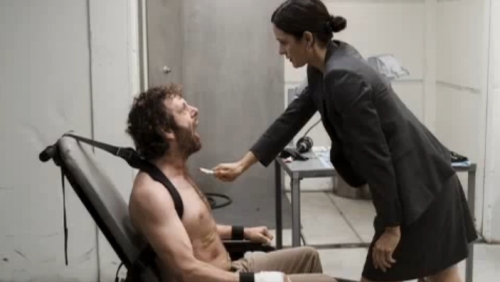
This is what would happen to the American people if confronted with this fact,
they would break down. Which is why upon researching reactions to the film one
of the most common opinions was that viewers found themselves wishing that the
torture had continued in order for the FBI to find the fourth bomb that they
were never told about. The audience was taken on a journey along with Agent Brody
and they felt the things that she felt, and it scared them. ‘H’ sum’s up her
character and the idea of the ignorant masses in a small piece of dialogue near
the end of the film. He says to her:
“I
have a condition. You. You go out there and drag those kids back in here
kicking, screaming and begging. You take them in there and strap them down,
'cause you're the only person here with any decency.”
She
ask’s him, “Why me?”
 And
he replies “Because if you can do it, then anybody can.”
And
he replies “Because if you can do it, then anybody can.”
Unthinkable
is impeccably written to relay to the audience that they are allowing their
Consent to be Manufactured by the people in control of their country.
CONCLUSION
To summarise, Manufacturing Consent is the
idea that the American ‘elites’ use the media to marginalise, divert, and
manipulate the masses under their control for their own agenda’s. Film being
one of the largest and most popular forms of media in modern society, can play
a huge role in this.
Through
examining the film Lone Survivor, it is clear to see that the messages within
are clouded by action and entertainment. The film uses the way it is structured
as well as its characters in order to distract the audience from the bigger
holes in the ‘true story’ that, if they saw them, would give them a reason to ‘think’
about why everything is going in the Afghanistan, which would mean that they
are no longer ‘under control’. The film sends out a message that the war may
not be great, but the war can make ordinary people great.
 By
comparing this with the film Unthinkable the difference between Pro and
Anti-War films became very clear. While Lone Survivor subverted the bigger
thoughts under action and violence, Unthinkable used violent characters to
bring them out into the open, even speaking them aloud. Unthinkable gave the
viewer a perspective similar to their own to follow and learn with and then
gave that viewers perspective; Agent Brody, an influential voice.
By
comparing this with the film Unthinkable the difference between Pro and
Anti-War films became very clear. While Lone Survivor subverted the bigger
thoughts under action and violence, Unthinkable used violent characters to
bring them out into the open, even speaking them aloud. Unthinkable gave the
viewer a perspective similar to their own to follow and learn with and then
gave that viewers perspective; Agent Brody, an influential voice.
While
obviously films are a form of entertainment and not just media, and are meant
to be enjoyed, it is clear from this essay that especially in the case of War
films, the audience needs to begin to pay attention to what they are being told
and what they are subconsciously beginning to listen to, otherwise, they risk
allowing the ‘elites’ to Manufacture their Consent without even realising it.

No comments:
Post a Comment